
Illegible paper logs
Impossible-to-read handwriting, incomplete details, lost or damaged notebooks. When you need an accurate history, paper lets you down. Digital data is structured and always retrievable.
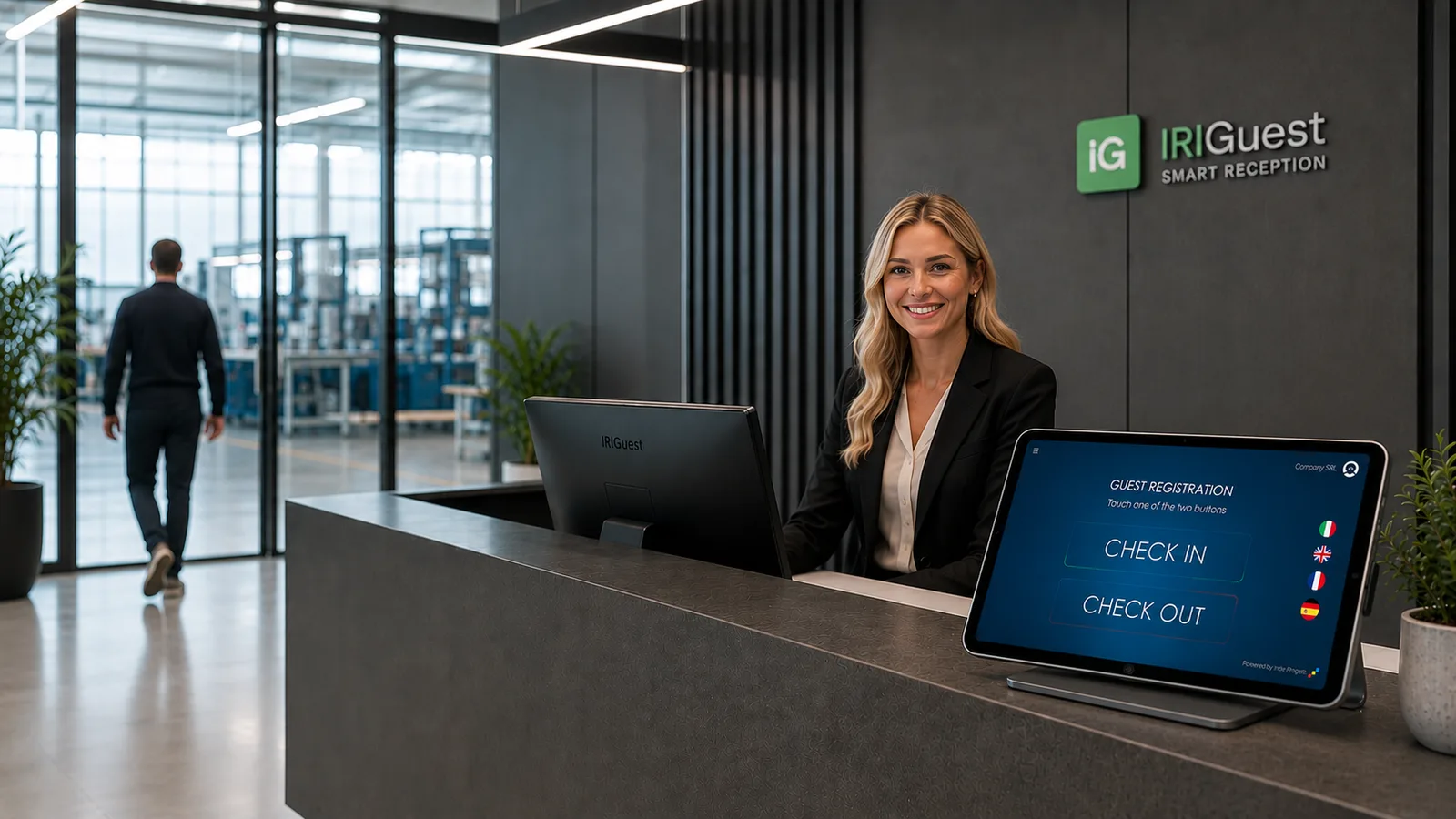
Company reception is evolving: more security, more efficiency and more control in managing visitors, suppliers and external technicians.
Discover how to turn your company's welcome into a digital, orderly and GDPR-compliant process.
In short
A digital reception replaces paper procedures at the front desk with digital tools: a tablet for guest check-in, automatic notifications to the host, QR-code badges and a digital log that respects the GDPR. The result is a more efficient, secure and professional welcome, without removing people from the process — it just helps them work better.
This guide is written for office managers, security officers, facility managers and anyone who wants to genuinely understand how it works — even if they never buy any software.
For decades, company reception ran on the same tools: a notebook where visitors wrote their name and signature, a phone to call the host, and — on a good day — a spreadsheet filled in by hand. Then something changed. Companies realised reception is the first physical contact with clients, partners, suppliers and candidates: the moment a first impression is made or lost. At the same time, the GDPR made the open paper log, readable by anyone, a real liability. The answer has been digital reception: a change that looks small on paper but has a concrete impact on efficiency, security and image.
A digital reception is a system — made of software, devices and processes — that makes managing company visitors more structured, traceable and professional. It is not necessarily an unstaffed touch kiosk: in most cases the receptionist stays, but with less paperwork, more real-time information and fewer chances of error.
The term covers a set of functions: digital guest registration on a tablet, automatic notification to the host, QR-code badge printing, a digital access log, privacy notice management and — in more advanced versions — integration with access control, turnstiles and gates. All of this replaces the notebook at reception, the improvised spreadsheet and the manual phone call to warn the host.
Comparing the two approaches makes it clear what changes — and why more and more companies are making the switch:
Traditional reception
Digital reception
A digital reception workflow is linear and fast. On average, a visitor completes check-in in under a minute. Here are the 8 stages that make up the process:
The visitor walks up to the tablet (or kiosk) placed at reception. They see a simple, clean screen, possibly customised with the company logo.
They enter their details — name, company, person or office to visit, reason for the visit if needed. Fields are configurable by the company to match its own needs.
The system shows the privacy notice required under GDPR Art. 13. The visitor accepts it digitally. If needed, they sign NDAs or internal rules on screen too.
As soon as check-in is complete, the declared host gets an instant alert: email, app push notification or SMS, depending on configuration. No phone call, no middleman.
The system generates a personalised badge with name, company, unique QR code, entry time and — if enabled — a photo taken at check-in. The badge prints in seconds.
The visitor enters the authorised areas. The QR-code badge can be scanned at turnstiles or gates to verify identity and authorisation. The system always knows who is on site.
On leaving, the visitor checks out on the tablet (or taps their badge on a reader). The system logs the time, closes the visit and updates the live list of people present.
Every entry is stored in the digital log: searchable, filterable, exportable. Useful for audits, ISO certifications, inspections and — in an evacuation — for knowing exactly who is still on site.
Digital reception exists to answer concrete problems that almost every company with a busy front desk or traceability duties knows well. Here they are, one by one:
Impossible-to-read handwriting, incomplete details, lost or damaged notebooks. When you need an accurate history, paper lets you down. Digital data is structured and always retrievable.
A spreadsheet doesn't send notifications, print badges or manage privacy. Whoever updates it forgets to, whoever reads it sees everyone's data. It works for low traffic; it stops being enough fast.
At peak times the receptionist juggles the phone, visitors, badges and logs at once. Digital automates the repetitive parts — registration, notification, badge — freeing up time for real hospitality.
Manual entry inevitably leads to mistakes: approximate times, missing hosts, missing company names. Digital validates required fields and standardises the data.
During an ISO audit or internal inspection, the reviewer needs an orderly, searchable, reliable history. A paper log is not up to the task: digital produces reports in seconds.
In case of a fire alarm or evacuation, the safety officer needs to know exactly who is on the premises at that moment. With paper, that's impossible. With digital, the list updates in real time.
The benefits of digital reception spread across several levels: from the company's image to operational security, from regulatory compliance to everyday efficiency.
First impressions count. An elegant tablet check-in communicates modernity and attention to detail before the visitor even meets anyone.
Registration, notification and badges are automated. The receptionist spends less time on admin and more on genuinely welcoming people.
Full traceability of who enters, when, why and who is escorting them. Unauthorised access is flagged in real time.
Notice built into the flow, data minimisation, automatic retention management. Privacy is by design, not an afterthought.
Digital, validated, structured data. No illegible handwriting, no blank fields, no approximate times.
A fast check-in, no queues, no waiting to be noticed. A smooth experience that respects the guest's time.
How many visits a month? What time do they peak? Which hosts receive the most guests? Useful data for optimising reception and demonstrating traceability during audits.
A centralised dashboard to manage multiple sites, multiple gates and multiple flows consistently. Full visibility, uniform governance.
Visitor data — name, surname, company, entry time, person visited — is personal data under Regulation (EU) 2016/679 (GDPR). Collecting it is processing, whether it happens on paper or on a tablet. The difference is that digital makes it far easier to respect the principles the GDPR requires.
Art. 13 of the GDPR requires the controller to provide a clear notice before or during data collection. With digital reception, the notice is built into check-in: the visitor reads it on the tablet, accepts it, and the system logs consent with date and time. With a paper log, this step is almost always neglected or handled poorly.
The GDPR requires collecting only the data strictly necessary for the stated purpose (Art. 5(1)(c)). A well-configured reception system lets you enable only the fields that are genuinely useful — and disable the rest. A paper notebook, by contrast, tends to accumulate unnecessary data or leave large blank fields.
Data must be kept only for as long as necessary, then deleted. With digital reception you can set automatic deletion once the company-defined period ends. With paper, selectively deleting individual records is materially impossible. To go deeper: how long to keep visitor logs.
The biggest flaw of the front-desk notebook is that every visitor sees the data of whoever signed before them. With digital, each check-in session is separate: the visitor only sees their own screen, and data is accessible only to authorised system users.
The GDPR guarantees the rights of access, rectification and erasure. With a digital register, answering an access or erasure request means a database search — done in seconds. With paper, it could mean manually leafing through years of logs.
Digital reception fits very different contexts. It isn't designed only for large companies or tech sectors: it works wherever there is a need to track access in an orderly, professional way.
A polished check-in for clients, partners and candidates. Personalised badge, host notification, a professional image from the first second.
Suppliers, drivers, external technicians: full access traceability for workplace safety, ISO audits and emergency management. Essential for health and safety regulations and for factory visitor management.
A centralised dashboard, a consistent process across every site. Each site logs its own access, but governance is unified and data is always available centrally.
Client confidentiality, appointment management, a polished image. No client sees who came before them: privacy is guaranteed by design.
Dedicated check-in for suppliers and external technicians, on-screen NDA signature, management of authorised access areas. Traceability of maintenance staff and drivers.
Fast badges for dozens or hundreds of attendees, a real-time attendance list, smooth check-in with no queues. Perfect for open days, conferences and trade fairs.
The cost of a digital reception is not fixed: it depends on several factors that vary considerably with company size, number of sites and required features. Here are the main elements that shape the budget.
Not every company needs digital reception today. But there are scenarios where the traditional system clearly shows its limits — and where switching to digital becomes not just useful, but necessary.
To better understand when it really pays to go digital, we have written two dedicated guides:
What Italian and EU law and the GDPR say. When a log is a legal duty and when it is simply good practice.
Read the guide ComparisonAn impartial analysis of the three approaches, with pros, cons and practical advice for every type of workplace.
Read the guideImplementing digital reception does not require months of planning. With a simple piece of software you can be up and running in hours. Here are the essential steps to get it right:
IRIGuest is an Italian software for digitally managing company visitors and reception. Available on iPad and Android tablets, with a free offline version and an advanced Cloud version for more structured companies. Among its main features:
Digital tablet check-in, configurable fields, built-in privacy notice, on-screen signature. Try it as our reception guest check-in app.
Instant generation and printing. Custom badges with logo, name, QR code and expiry. Try the free badge generator.
The host is notified by email or push. Access reports, visitor history and aggregated statistics from the Cloud dashboard.
A free version is available on the App Store and Google Play. No credit card, no time limit. Or try the online demo directly in your browser.
Tell us about your reception — number of sites, visitor types, privacy requirements — and we will reply with practical guidance and, if useful, a short Cloud demo.
Digital reception is a system that replaces paper procedures at the front desk with digital tools: a tablet for guest registration, automatic notifications to the host, QR-code badges and a GDPR-compliant digital log. It does not remove people from the process: it makes their work more efficient, more secure and more professional.
The typical workflow has 8 stages: (1) the visitor arrives, (2) they register on the tablet, (3) they accept the privacy notice, (4) the host is notified automatically, (5) a QR-code badge is printed, (6) they access the premises, (7) they check out on leaving, (8) the visit is archived in the digital history. All without paper, in under a minute.
No. Digital reception does not replace people: it supports the receptionist by automating the admin work — filling in the log, notifying the host, printing the badge — so the person can focus on genuine hospitality. In many contexts, a human presence remains essential for handling special cases and making guests feel welcome.
The cost depends on several factors: the software (many offer free versions to start with), hardware (tablet, an optional kiosk), a badge printer, the number of sites and staff training. Solutions like IRIGuest let you start at zero cost with the free version, and move to an advanced plan only when you need extra features.
Yes, absolutely. Digital reception solutions are scalable: an SME with 5-10 visitors a day already benefits from a structured log — fewer errors, more confidentiality, a more professional image, GDPR compliance without extra effort. The upfront investment is often minimal or zero thanks to free versions.
A well-designed digital reception system builds the privacy notice into the check-in flow, collects only necessary data (minimisation), manages retention periods and ensures confidentiality by preventing one visitor from seeing another's data. GDPR compliance also depends on configuration and on the data controller, but digital makes compliance far easier than a paper log. Learn more in our guide to visitor logs and the GDPR.
The visitor approaches the tablet at reception, enters their details (name, company, person to meet), reads and accepts the privacy notice and, if required, digitally signs any NDAs. The process typically takes under a minute. Required fields are configurable by the company.
The most common device is a tablet (iPad or Android) on a stand at reception. Some solutions also support a PC or a dedicated kiosk. To get started, a tablet the company already owns is enough — no dedicated hardware purchase is required. With IRIGuest, one tablet is all you need to be operational.
Yes. Many digital reception solutions include generating and printing QR-code badges, customisable with name, company, logo, an optional photo and an access duration. The badge prints in seconds after check-in and can be used to verify identity or access specific areas. You can also generate free QR-code badges with our online tool.
Yes. One of the key features of digital reception is automatic notification: as soon as the visitor completes check-in, the host receives an alert by email, app push notification or SMS, depending on configuration. This removes the dependence on a phone call from reception as the only channel.
During an evacuation or emergency, the system keeps a real-time list of who is on the premises — including visitors who have checked in but not yet checked out. The safety officer can consult this list to run a headcount and coordinate with emergency services. This is a critical function for workplace safety regulations.
Yes. Advanced versions of digital reception software (such as IRIGuest Cloud) let you manage multiple sites from a centralised dashboard: each site runs its own registration flow and devices, but the data is accessible centrally, with aggregated reports and consistent governance.
"Visitor management software" and "digital reception" are often used as synonyms. Strictly speaking, digital reception describes the outcome — a digital, traceable and professional welcome process — while visitor management software is the tool that makes it possible. A well-implemented digital reception combines software, hardware (tablet, badge printer) and organisational processes.
Data is kept in the digital log for the period the company defines based on the purpose of processing and GDPR principles. Once that period expires, data can be deleted selectively and with a clear record — an operation that is practically impossible with a paper log. Visitors keep their rights (access, rectification, erasure) as set out in the Regulation. Read our guide on visitor log retention.
With simple software like IRIGuest, you can be up and running in a few hours: install the app on a tablet, configure the fields to collect, set up the privacy notice and you're ready. For a more advanced setup — badge printing, email notifications, multiple sites, access-control integration — expect 1-2 working days. The online demo lets you evaluate the product without installing anything.